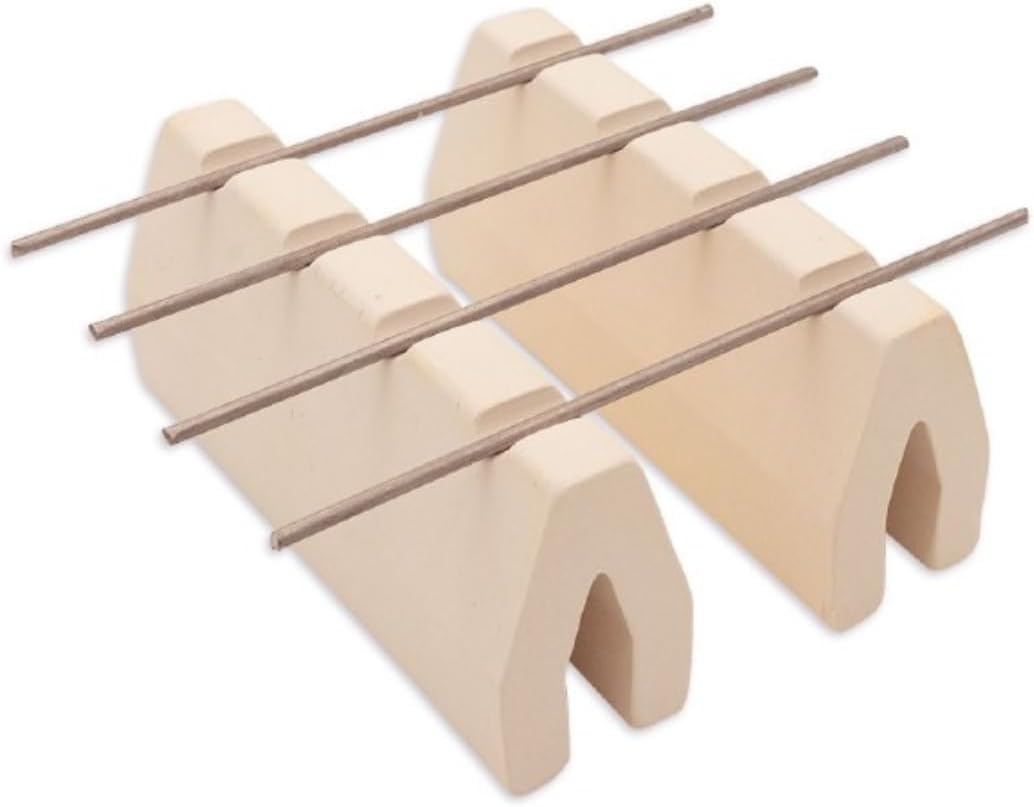
If you’ve ever opened a kiln expecting a tray of fired ceramic pendants and found them fused to your shelf, tilted at odd angles, or cracked through the hanging hole, you already understand why the hardware matters as much as the firing schedule. Kiln furniture — the collective term for the stilts, posts, shelves, pins, and hanging rods that physically hold your work during a firing — is one of the least glamorous but most consequential decisions in a jewelry-scale studio. For pieces like beads (small, often drilled, fired on a rod or wire so the hole stays open) and pendants (flat or sculptural pieces with a single hang hole or bail attachment point), the challenge is specific: you need to keep the piece elevated off the shelf, prevent it from slumping or distorting, and preserve that critical hole or loop through temperatures that can reach 2,300°F (cone 6) or higher. This guide walks through the rack systems and hanging hardware that experienced ceramic jewelry makers rely on, with clear tradeoffs at every decision point so you can match the solution to your kiln, your clay body, and your production volume.
| EDITOR'S PICK[AMACO Small Bead Rack for Potte…](https://www.amazon.com/dp/B01M59WZS7?tag=greenflower20-20) | Mid-tierReusable Hanging Kiln Tools - H… | Budget pick300 Pieces High Temperature Nic… | |
|---|---|---|---|
| Type | Bead rack | Firing holders | Jump rings |
| Material | Nichrome, stoneware | — | Nichrome, plastic |
| Height | 2" | — | — |
| Wire Qty | 4 | — | 300 |
| Wire Length | 6" | — | — |
| Case included | — | — | ✓ |
| Price | $25.99 | $19.19 | $11.99 |
| See on Amazon → | See on Amazon → | See on Amazon → |
Why Generic Kiln Furniture Fails Jewelry-Scale Work
Most kiln furniture is designed around functional pottery — mugs, bowls, plates — where the dominant concern is keeping a flat foot ring off the shelf so it doesn’t stick. Jewelry work has a completely different geometry. Your pieces are small (often under 3 inches), lightweight, frequently perforated, and often glazed on all visible surfaces including the back. That last point is where standard shelf-and-stilt setups fall apart.
A stilt is a small, spider-leg ceramic support that holds a piece above the shelf on three or four sharp points, allowing glaze to cover the bottom without the piece welding itself to the kiln shelf. Stilts work reasonably well for small tiles and thick pendants, but they leave witness marks — tiny glaze scars at each contact point. For jewelry work, where the back of a pendant is often visible, those marks are a production defect, not a cosmetic nuisance.
The better approach for most ceramic jewelry is suspension firing: hanging the piece from a rod or wire so that nothing touches the back surface at all. This is where dedicated bead-firing rack systems come in, and where the quality of your hardware starts to matter in measurable ways.
The core tradeoff you’re managing: Suspension systems eliminate back-surface contact marks but require a pre-existing hole or loop in the piece. Stilt systems require no hole but leave contact marks. Setters and custom refractory forms (discussed below) split the difference but add cost and workflow complexity. Know which problem you’re solving before you buy.
Bead Racks, Firing Pins, and Suspension Hardware: The Actual Options
Nichrome Wire and Rod Systems
Nichrome (nickel-chromium alloy) wire is the workhorse of bead and pendant firing. It tolerates repeated high-temperature cycles without significant oxidation or structural failure, doesn’t bond to most clay bodies or glazes, and is inexpensive enough that you can replace it when it eventually fatigues. Published spec sheets from kiln accessory suppliers typically rate 18-gauge nichrome for use up to cone 10 (approximately 2,350°F / 1,285°C).
The standard setup: a nichrome rod (12–16 gauge, stiffer) spans a bead rack frame, and individual beads are threaded onto it through their drilled holes. Pendants with a single hang hole can be hung from a shorter length of 20–22 gauge nichrome wire looped through the hole and draped over the rod.
What practitioners report: Ceramic Arts Network’s coverage of ceramic jewelry production consistently notes that the most common failure mode isn’t the nichrome itself but the fit between the bead hole and the rod diameter. Too tight, and the bead can crack as it expands during heating; too loose, and the bead slides and fuses against its neighbor. The working rule of thumb documented by several production ceramic jewelry makers is to drill bead holes at least 1.5× the diameter of the firing rod — accounting for clay shrinkage (typically 10–13% for mid-fire stoneware) before the hole closes down around the wire.
By the numbers:
- Typical clay shrinkage: 10–13% (mid-fire stoneware), 12–15% (porcelain)
- Safe bead hole-to-rod clearance after shrinkage: minimum 0.5mm gap
- Nichrome 18-gauge wire rated temperature ceiling: ~cone 10 (2,350°F / 1,285°C)
- Nichrome replacement interval (production studio use): approximately every 50–80 firings, per aggregated studio reports
Commercial Bead Rack Frames
Several suppliers manufacture dedicated bead rack frames — typically a rectangular refractory or steel frame with slots or holes to accept nichrome rods at regular intervals. These solve the problem of keeping rods level and evenly spaced without improvising a jig each firing. Paragon Industries’ accessory documentation lists bead tree and bead rack configurations specifically sized for their smaller kilns (the Paragon Caldera and Paragon SC series are popular for jewelry work). Skutt’s accessory reference similarly covers bead racks dimensioned for their KM-614 and KM-818 interior footprints.
The practical advantage of a commercial frame over DIY nichrome-across-posts is repeatability: every firing, the rods sit in the same position, which matters when you’re dialing in a consistent firing schedule for production work.
If you’re running a Paragon Caldera or similar small front-loader as your dedicated jewelry kiln, a purpose-built bead rack that fills the chamber efficiently is worth the $40–$80 investment. If you’re firing jewelry in one section of a larger production kiln (a Skutt KM-1027 or L&L e28T, for example), a rack system that occupies one shelf while pots occupy others is the more flexible choice.
Pendant Hangers and T-Pins
For flat pendants, earring components, and small tiles with a single hole, T-pins (an L- or T-shaped nichrome pin that hooks through the hang hole and rests on a rod or rack rail) give you more control over positioning than threading. The piece hangs freely, can be spaced without touching neighbors, and the contact point — the inside of the hang hole — is almost never a visible surface on finished jewelry.
Practitioners working in fine porcelain jewelry (a segment Ceramic Arts Network covers extensively in its jewelry-focused issues) note that T-pin systems work especially well for thin pieces prone to warping, because suspension allows heat to reach all surfaces evenly without the differential heating that shelf contact can cause.
The tradeoff: T-pins require that your hang hole be drilled and cleaned before bisque firing, and that it be large enough (post-shrinkage) to accept the pin gauge. For delicate porcelain with very fine holes, this is a real constraint.
Setters, Shelves, and Custom Refractory Forms
Not every piece has a hole, and not every design accommodates one. For solid pendants, cameo-style tiles, or pieces where drilling would compromise the design, setters — custom-shaped refractory clay forms that cradle the piece during firing — are the production solution.
A setter is essentially a negative of your piece’s back surface, fired separately to create a stable, reusable form. The piece rests in it during glaze firing, supported evenly without touching the shelf. Because the setter is made from the same or similar clay body, shrinkage rates are matched and the piece doesn’t drag or torque during the firing.
The Craft Council UK’s studio practice notes for small-scale ceramic production describe setter systems as standard practice in production jewelry studios making more than 200–300 units per firing cycle — the point at which the time investment in making setters is recovered in reduced loss rates.
If you’re not at production volume yet, a shelf of low-fire stilts (ceramic stilts with metal points, rated to cone 06–04 for earthenware) combined with careful back-glaze masking is a reasonable interim approach. You accept small contact marks on the back surface, which may be hidden by a finding or bail anyway.
Metal Clay and Glass Fusing: Adjacent Hardware Considerations
Metal clay practitioners (working in fine silver, copper, or bronze clay that burns away the binder and sinters the metal particles during firing) use a slightly different hardware vocabulary. Because metal clay firing temperatures are lower (fine silver sinters around 1,650°F / 900°C, well below cone 06), fiber blanket or fiber board squares serve as the primary firing surface — not kiln shelves. Ceramic Arts Network’s metal clay firing coverage notes that kiln wash is unnecessary on fiber board surfaces because metal clay doesn’t stick the way glazed ceramic does.
For glass fusing work at the pendant scale — dichroic cabochons, fused glass earrings — the critical hardware is thinfire shelf paper (a single-use fiber paper that prevents glass from bonding to the shelf) combined with fiber board shelves. Manufacturers of fusing-specific shelf paper, including brands documented in glasscampus.com’s fusing resources, rate their products for use up to approximately 1,700°F (927°C), which covers most fusing and slumping work.
The decision rule for mixed-discipline studios: If you’re firing ceramic jewelry and glass pieces in the same kiln on different days, stock both fiber board (for glass) and standard cordierite shelves with kiln wash (for ceramic). Don’t cross-contaminate — kiln wash residue on a fiber board surface can cause glass to devitrify (lose its gloss through surface crystallization).
Choosing the Right System: The Decision Framework
Here’s how to match hardware to your situation:
If your pieces have drilled holes and you’re doing any real production volume: Invest in a nichrome rod rack system — either commercial or DIY — and standardize your hole diameter relative to your rod gauge. The Ceramic Arts Network’s production jewelry coverage and Paragon’s accessory documentation both support this as the default approach for bead and pendant work above hobbyist quantities.
If your pieces are solid (no hang hole) and you’re in low-to-mid volume: Use stilts and accept back-surface contact marks, or invest time in making setters. The setter path pays off once you’re firing the same design repeatedly.
If you’re working in metal clay or fine silver: Skip the kiln shelf entirely for firing; fiber board plus a fiber blanket tent (to hold heat around small pieces) is the documented standard.
If you’re firing glass jewelry alongside ceramic work: Keep the hardware physically separated and never use kiln wash on surfaces that will touch glass.
If you’re scaling up and your loss rate from warping, sticking, or cracking is above 5–8% per firing: That’s the threshold where investing $150–$300 in better rack hardware pays back in a single month of reduced losses. The math is straightforward — calculate your average piece value, multiply by your current loss rate per firing, and compare against hardware cost.
The right system isn’t the most elaborate one; it’s the one that matches your clay body, your hole geometry, and your production rhythm. Start with nichrome and a basic rack, track your loss rate honestly, and upgrade the specific bottleneck when the numbers tell you to.
For more on kiln sizing decisions that affect how much jewelry work you can batch per firing, see our guide to interior cubic footage and shelf configuration. If you’re evaluating a dedicated small jewelry kiln versus reserving a shelf in a production kiln, our kiln comparison tool can help you run the numbers on firing cost per piece.