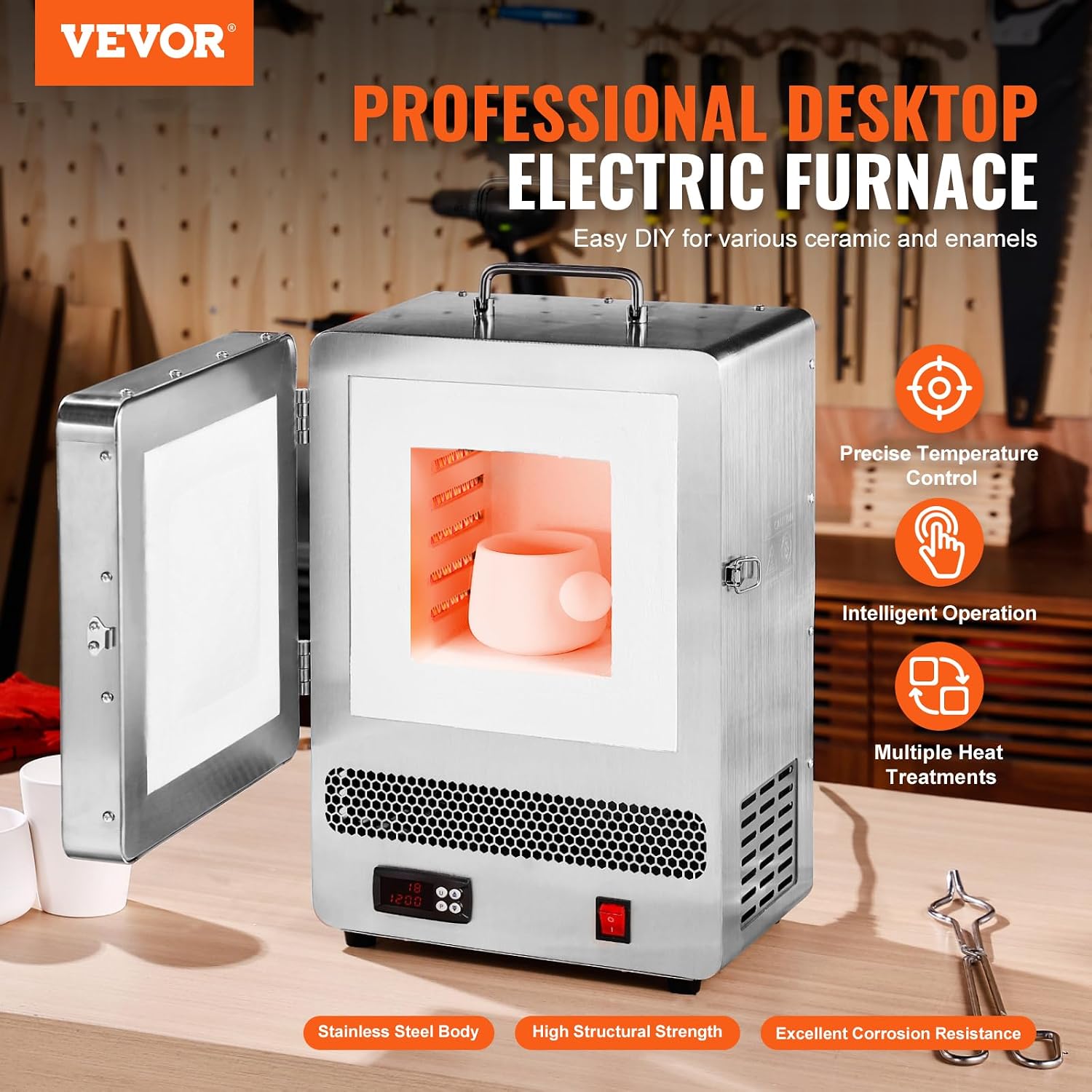
A kiln is essentially an insulated electric (or occasionally gas-fired) oven engineered to reach temperatures far beyond anything a kitchen range can produce — typically between 1,100°F and 2,350°F — in order to permanently harden clay, fuse glass, or fire metal clay. If you’re new to the hobby or researching your first purchase, the sub-$400 category probably caught your eye because the price feels manageable. That instinct makes sense. But before you click “buy,” it’s worth understanding exactly what you’re purchasing, what those kilns genuinely can’t do, and how to recognize the moment when you’ve outgrown one. This guide walks through all three: the real capabilities of compact budget kilns, their hard limits, and the concrete upgrade path into the $800–$2,500 range where serious studio work becomes possible.
What a Sub-$400 Kiln Actually Gives You
Let’s be precise about the category. Kilns retailing under $400 as of mid-2026 are almost universally small-batch test kilns or jewelry-scale units — interior volumes typically range from 0.1 to roughly 0.5 cubic feet (about the size of a shoebox or smaller). They are almost always front-loading or top-loading tabletop units, drawing between 120V/15A and 120V/20A from a standard household outlet. That last point is their single most important selling feature: you plug them in like a toaster oven. No electrician required, no panel upgrade, no dedicated 240V circuit.
Brands that show up consistently in this price band include AIM Kilns (their AIM 64 and AIM 120 models are frequently cited in Ceramic Arts Network beginner guides), Skutt’s Firebox series at its entry configurations, and a range of imported tabletop units sold under multiple house brands. Paragon’s Caldera sits just above this price ceiling at $800–$1,000 but is the most commonly named “next step” target, which is useful context for the upgrade conversation below.
What these kilns do well:
- Metal clay firing. Fine silver and bronze metal clay — a material that starts as a paste, dries to a greenware state, and then is fired to burn away the binder and sinter the metal particles together — typically fires between 1,100°F and 1,650°F depending on alloy. A compact tabletop kiln hits this range comfortably. Metal clay practitioners on forums consistently report that small kilns are adequate for pendant-scale and ring-scale work.
- Glass fusing at lower temperatures. Bullseye and Spectrum 96 glass fuse and tack-fuse in the 1,250°F–1,500°F range. Compact kilns can manage this, with caveats about ramp rate control (more on that shortly).
- Test tiles and glaze testing. If you are developing a new glaze recipe and want to fire small test tiles before committing to a full bisque load, a compact kiln is genuinely useful as a test unit even once you own a larger kiln.
- Low-fire ceramics to cone 06–04 (~1,828°F–1,945°F). Some compact kilns in this range are rated to cone 06. This opens the door to earthenware and low-fire decorative work — not cone 6 stoneware or cone 10 reduction, but functional for a beginner making decorative tiles or jewelry components.
By the numbers — typical sub-$400 kiln specs:
| Feature | Typical range |
|---|---|
| Interior volume | 0.1 – 0.5 cu ft |
| Max temperature | 1,650°F – 2,000°F (cone 06 to cone 1) |
| Circuit requirement | 120V / 15–20A standard outlet |
| Controller type | Infinite switch or basic digital |
| Warranty | 1 year (elements often not covered) |
The Hard Limits — Where Budget Compact Kilns Break Down
Here’s where the tradeoffs get concrete. Understanding these limits is the difference between making a smart entry-level purchase and making a frustrating one.
Temperature ceiling. Most sub-$400 kilns max out around cone 1 (roughly 2,080°F) under ideal conditions. Mid-fire stoneware (cone 6, approximately 2,232°F) is out of reach. High-fire porcelain (cone 10, ~2,345°F) is completely off the table. If you’re planning to throw functional stoneware mugs or bowls, a sub-$400 kiln cannot get you there. Per Ceramic Arts Network’s kiln selection resources, cone 6 is the practical minimum for most functional pottery, which means this entire price band is structurally incompatible with that goal.
Ramp rate control. Ramp rate refers to how quickly the kiln heats up or cools down — measured in degrees per hour. Controlled ramping matters enormously in glass work (rapid heating can crack glass; rapid cooling through certain temperature ranges causes thermal shock) and in reduction cooling schedules for ceramics. Budget compact kilns typically offer either a simple infinite switch (essentially a dial from low to high, like a stovetop burner) or a basic single-segment digital controller that lets you set a target temperature but not a nuanced heating schedule. Compare that to a Skutt KM-818’s built-in Bartlett Genesis controller or the DynaTrol on L&L’s entry-level models, which allow you to program multiple segments — heat at 100°F/hour to 1,000°F, hold for 20 minutes, ramp to 1,800°F at 200°F/hour, and so on. Without multi-segment programmability, you’re relying on judgment and manual intervention rather than repeatable, documented firing schedules.
Interior volume and production reality. At 0.1–0.5 cubic feet, you can fire a handful of small pendants or a few test tiles per load. If you’re making anything for sale — or even making gifts for friends — you’ll hit the throughput wall within months. The Craft Council’s studio equipment guides note that production viability generally requires a minimum of 3–5 cubic feet of interior space for any small-batch commercial operation.
Element longevity and serviceability. Kiln elements — the coiled wire components that generate heat — wear out and need replacement. In well-supported kilns like those from Skutt, L&L, and Paragon, replacement elements are documented, priced, and available; the repair is a well-understood DIY task. In budget compact kilns, elements are often proprietary to import runs, poorly documented, and sometimes unavailable within 18–24 months of purchase. Owners across aggregated reviews consistently flag this as the primary frustration: the kiln works fine for a year, an element fails, and replacement parts don’t exist. You’ve effectively purchased a disposable appliance rather than a capital asset.
The Upgrade Path: Reading the Signals, Then Acting
Here’s the practical decision frame. Compact budget kilns are legitimate tools for a specific use case — not a scam, not a waste of money in the right context. But they are a dead end if your ambitions grow. The question is recognizing the inflection point.
You’ve outgrown a sub-$400 kiln when:
- You want to fire stoneware to cone 6 or above.
- You’re doing glass work that requires precise multi-segment schedules.
- You’re producing work for sale and your load size limits your output.
- An element has failed and parts are unavailable.
- You’re firing more than 2–3 times per week and the kiln is running at maximum temperature every time (this degrades elements and controllers faster than intermittent use).
The first real upgrade tier: $800–$2,000.
This is where purpose-built studio kilns begin. The Paragon Caldera (frequently cited in paragonweb.com’s beginner documentation) is a compact top-loader rated to cone 10, with a multi-segment digital controller, at around $800–$1,000. It still draws 120V but at a dedicated 20A circuit — you may need a single outlet upgrade, not a full panel job. For anyone doing metal clay, porcelain jewelry, or small glass work who wants real programmability and cone 10 headroom, the Caldera represents a qualitative step change, not just a size upgrade.
The Skutt KM-818 — Skutt’s entry-level full-featured studio kiln — is rated to cone 10, offers 0.97 cubic feet of interior space, and comes with the Bartlett Genesis controller that serious ceramic artists recognize as the industry baseline for programmability. Per Skutt’s published specifications, it draws 240V/20A, which means a dedicated circuit is now required. Budget roughly $150–$300 for a licensed electrician to run the circuit if you don’t already have one. Fold that into your total cost calculation. At approximately $1,200–$1,500 in 2026 pricing, the KM-818 is the canonical answer to “I’ve outgrown my starter kiln and want a real tool.”
The mid-range workhorse tier: $2,500–$5,000.
Once your practice is established and volume or specialty requirements push you further, this tier opens substantially larger interior volumes (7–14 cubic feet), better element configuration for even heat distribution, and controllers with documented firing logs. The Skutt KM-1227 (approximately 14.1 cubic feet) and the Paragon Dragon 24 compete directly here. The decision between them turns on specific details — the Dragon 24’s quad-element design versus the 1227’s three-zone control, amperage requirements (the 1227-3 draws 48A on a 240V circuit, which has panel upgrade implications) — that a separate guide covers in depth.
If your discipline is specialty work — borosilicate glass, raku, or production metal clay — the upgrade path may not follow the standard ceramic ladder at all. Jen-Ken kilns (hotkilns.com publishes detailed specialty application guides) and Olympic’s fiber kilns are optimized for raku’s rapid heat-and-cool cycles in ways that general-purpose studio kilns aren’t. Know your discipline’s thermal profile before you buy.
The Decision Rule
Here’s the clear if/then frame this decision deserves:
If you are an absolute beginner making jewelry-scale metal clay or low-fire decorative ceramics, firing once a week or less, and you genuinely don’t know yet whether the hobby will stick — a sub-$400 compact kiln is a reasonable entry point. Treat it as a proof-of-concept purchase, not a studio investment.
If you already know you want to make functional stoneware, do serious glass fusing, or produce work for sale — skip the sub-$400 tier entirely. The money spent there doesn’t credit toward your next kiln; it’s gone. Put that $400 toward the $1,200–$1,500 range and buy the Paragon Caldera or Skutt KM-818 as your first kiln. The electrician cost is real but one-time.
If you own a compact kiln and an element has failed or can’t be replaced — that’s your signal. Don’t repair; redirect the budget upward. The compact kiln has done its job as a learning tool.
The upgrade path in kilns, unlike many equipment categories, is not a gradual continuum. It has discrete steps defined by electrical infrastructure, cone rating, and controller capability. Understanding where those steps are — and which side of the line your current work sits on — is the core analytical skill this purchase decision requires.
For a deeper look at the $800–$2,000 tier where the real studio journey begins, see our guide to entry-level studio kilns and the cone 6 vs. cone 10 decision. For specialty applications in metal clay and porcelain jewelry, the temperature profile and kiln selection guide for small-scale precious metal work covers the Jen-Ken and AIM Kilns comparison in detail.