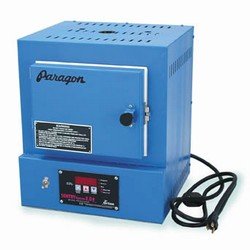
An electric kiln is essentially a well-insulated box lined with heating elements — coiled metal wires that glow red-hot and raise the interior temperature to anywhere between 1,000 °F and 2,400 °F, depending on what you’re firing. The temperature you fire to is described in “cones” — a standardized scale ceramicists use because cone ratings account for both temperature and the rate at which the kiln heats, which matters more to clay and glaze chemistry than a raw number alone. If you’ve started shopping, you already know that kilns are sized by interior cubic footage and priced on a steep curve: a 0.5 cubic foot test kiln runs under $400, while a 22-cubic-foot production workhorse clears $6,000. What most beginner guides skip is the middle calculation — how much interior space you actually need for your real monthly output, and what that choice will cost you in electricity every time you press Start. That’s exactly what this guide works through.
| EDITOR'S PICK[Paragon SC2 Programmable Digita…](https://www.amazon.com/dp/B002N7CCHC?tag=greenflower20-20) | Mid-tierElectric Ceramic Kiln 220V 1PH… | Budget pickTECHTONGDA Electric Kiln Compac… | |
|---|---|---|---|
| Power | 1680W | 2.5KW | — |
| Voltage | 120V | 220V | 220V |
| Max Temp | — | 2336°F | 2336°F |
| Capacity | — | 0.6 cuft | — |
| Programmable | ✓ | — | — |
| Shape | — | Hexagonal | Hexagonal |
| Price | $1,550.00 | $1,029.00 | $1,005.00 |
| See on Amazon → | See on Amazon → | See on Amazon → |
Why Cubic Footage Is a Trap If You Size by Ambition, Not Output
The most common first-kiln mistake isn’t buying cheap — it’s buying big. The logic feels sound: a larger kiln gives you room to grow, you can always fire a half-load, and the per-piece cost comes down as you scale. In practice, firing a partially loaded kiln is wasteful in two ways that compound each other.
First, a kiln that runs half-full takes nearly as long to reach temperature as a full one, meaning you spend nearly the same electricity per firing cycle while producing fewer finished pieces. Second, underfired loads are a thermal stress problem: uneven heat distribution worsens when there’s less mass in the chamber to absorb and moderate temperature swings.
The right question isn’t “how big could I fill?” — it’s “how often do I actually fire, and how many pieces does each session produce?”
Here’s a practical sizing exercise. Track your greenware output — the raw, unfired work — over four to six weeks. Count how many pieces you produce per working session and measure their approximate volume in cubic inches (length × width × height, loosely). Ceramicartsnetwork.org’s kiln-selection resources suggest a useful rule of thumb: allow roughly 10–15% packing overhead above your calculated piece volume to account for kiln furniture (the shelves and posts used to stack work), air circulation between pieces, and glaze drip guards.
A typical home studio potter making mugs and small bowls — say, a dozen 12-ounce mugs per session — is usually working with 150–200 cubic inches of piece volume per firing. That translates comfortably into a 0.5–1.0 cubic foot interior (1 cubic foot = 1,728 cubic inches). Moving up to dinner plates, medium vases, or tile production pushes you toward 1.5–3.0 cubic feet. Serious production work — repetitive sets of lidded jars, platters, or sculpture in the 12″–18″ range — starts justifying the 5–7 cubic foot range.
Electrical Reality: What Your Panel and Your Utility Bill Actually Say
This is where the math gets specific, and it’s worth doing before you fall in love with a particular model.
Electric kilns are rated in kilowatts (kW) — a measure of how much power they draw. The larger the kiln and the higher the cone rating, the more kilowatts. Most residential home studios run on either a 120-volt or 240-volt circuit; nearly all kilns above 0.5 cubic feet require a dedicated 240-volt circuit because 120 volts simply can’t deliver the current needed for serious cone-6 or cone-10 firing without tripping breakers or damaging wiring.
By the numbers — representative spec comparisons (published manufacturer data, May 2026):
| Model | Interior Volume | Max Cone | Amperage | Approx. kWh per Cone-6 firing |
|---|---|---|---|---|
| Skutt KM-818 | 0.77 cu ft | Cone 10 | 30A / 240V | ~7–9 kWh |
| Paragon Caldera | 0.64 cu ft | Cone 10 | 30A / 240V | ~6–8 kWh |
| Skutt KM-1027 | 2.15 cu ft | Cone 10 | 48A / 240V | ~18–22 kWh |
| L&L Easy-Fire e18T | 1.75 cu ft | Cone 10 | 48A / 240V | ~16–20 kWh |
| Paragon Dragon 24 | 3.4 cu ft | Cone 10 | 60A / 240V | ~28–34 kWh |
kWh figures are ranges drawn from published spec sheets and operator-reported firing logs cited in Ceramicartsnetwork.org forum documentation. Actual consumption varies with firing schedule, load density, and element age.
To translate kWh into dollars, you need your local electricity rate. Per the U.S. Energy Information Administration’s May 2026 data vintage, the national average residential rate sits at approximately $0.17–$0.19 per kWh, with coastal states (California, Massachusetts, New York) running $0.25–$0.35 per kWh and several Midwestern states still below $0.13.
The math at national average ($0.18/kWh):
- A Skutt KM-818 cone-6 firing: ~$1.44–$1.62 per firing
- A Skutt KM-1027 cone-6 firing: ~$3.24–$3.96 per firing
- A Paragon Dragon 24 cone-6 firing: ~$5.04–$6.12 per firing
Fire the Dragon 24 twice a week and you’re at $520–$640 per year in electricity alone. That’s not an argument against a larger kiln — it’s an argument for choosing the right size so you’re firing full loads, not burning electricity on half-empty chambers.
One critical pre-purchase step that Skutt’s own documentation on skutt.com emphasizes: verify your panel capacity before you buy. A 48-amp kiln requires a 60-amp dedicated circuit (National Electrical Code requires a circuit rated at 125% of continuous load). If your panel is already loaded with a dryer, an air compressor, and a water heater, adding a 60-amp circuit may require a panel upgrade — a cost that can run $800–$2,500 depending on your region and the age of your service entrance. Budget that in before you calculate whether a larger kiln “pays off.”
The Entry-Level Sweet Spot: Models Worth Evaluating in the $800–$2,500 Range
For a home studio potter or glass fuser firing 1–3 times per week, the practical field narrows to a handful of models that consistently appear in Ceramic Arts Network practitioner discussions and are supported by established dealer networks.
The Skutt KM-818 is one of the most-referenced entry kilns in the United States, and for good reason. Published specs show a 0.77 cubic foot interior, cone 10 capability, and 30-amp 240V service — manageable on most residential panels without an upgrade. Owners consistently report reliable element longevity and accessible parts availability, which matters enormously when you’re three years in and need a quick element swap without a weeks-long wait. Skutt’s documented controller options include the manual Kiln Sitter (a mechanical cone-sensing shutoff device) and the digital KilnMaster, which lets you program multi-segment firing schedules — useful for slow-cool glazes or glass annealing cycles.
The Paragon Caldera competes directly with the KM-818 in both price and footprint. Paragonweb.com’s spec documentation notes a slightly smaller interior (0.64 cu ft) but a comparable 30-amp service requirement and cone 10 rating. Paragon’s strong suit, per aggregated reviews, is build quality in the lid and hinge mechanism — relevant for glass fusers who open and close lids more frequently than ceramicists.
The L&L Easy-Fire e18T steps up to 1.75 cubic feet and enters the 48-amp tier. L&L’s published documentation at llkilns.com highlights the hard ceramic element holders (channeled into the brick rather than mounted on pins) as a distinguishing durability feature — a design that operators in long-run reviews note reduces element sag and contact failures over multi-year use. If your output is already pushing past a dozen pieces per session, this is the model worth the jump.
For glass fusers specifically, Paragon’s fusing-oriented lines (the Fusion series) and Jen-Ken’s AF series appear repeatedly in glass studio sourcing discussions. Both are designed with shallower chambers and programmable controllers suited to the precise slow-cool ramps (called “annealing schedules”) that prevent thermal cracking in fused glass — a profile that differs meaningfully from standard ceramic firing curves.
If X, Then Y: A Decision Rule for Your Specific Situation
After running the output math and the electrical math, the decision usually resolves cleanly. Here’s the framework:
If you produce fewer than 15 small-to-medium pieces per session and fire once or twice a week: The KM-818 or Paragon Caldera is the right tool. You’ll fire full loads, keep electricity costs under $3 per firing, and avoid an electrical panel upgrade. The “small” kiln is not a compromise — it’s a correct match.
If you’re already selling work, firing 3+ times per week, or making work larger than 10 inches in any dimension: Jump directly to the 1.5–2.5 cubic foot tier (L&L e18T, Skutt KM-1027). The higher electricity cost per firing is offset by the higher piece count per load, and the amperage requirement (48A / 60A circuit) is worth the upfront panel investment.
If your primary medium is glass fusing or metal clay: Cubic footage is less important than controller precision and chamber geometry. Prioritize a kiln with a programmable digital controller capable of multi-segment schedules and dedicated hold (soak) times — the Paragon fusion line and AIM Kilns’ 64 are both worth spec-comparing in this context. Metal clay practitioners, per Ceramicartsnetwork.org’s metal clay resource guides, often fire in very small test kilns (sub-0.5 cu ft) precisely because their piece volumes are small and precise temperature holds matter more than interior space.
If you’re buying for a community studio or university setting: You’ve outgrown this guide’s scope — that’s the territory covered in our institutional kiln specification guide — but the same output-matching logic applies at larger scale.
The underlying principle doesn’t change regardless of budget tier: a kiln is not a storage unit you fill with ambition. It’s a tool you size to your actual production rhythm. Get that match right, run the electrical numbers against your local utility rate, confirm your panel can support the circuit, and the purchase decision becomes a lot less mysterious — and a lot less likely to leave you with a half-empty chamber burning electricity you didn’t need to spend.
Related resources on KilnOven.com: See our kiln electricity cost calculator to run your specific kWh estimate by model, our guide to reading kiln spec sheets (amperage, phase, and cone ratings explained), and our comparison of digital controllers — KilnMaster vs. DynaTrol vs. Genesis — for programmable firing schedules.