Pottery is the practice of shaping clay — an earthen, workable material — into functional or sculptural objects, then hardening those objects permanently through heat in a kiln (a high-temperature oven designed for ceramics). If you’re just starting out, the equipment landscape can feel enormous: wheels, bats, trimming tools, wedging boards, protective aprons, slop buckets, and a kiln waiting at the end of it all. This guide cuts through that noise. It’s aimed at artists who’ve taken a class or two, know the difference between a greenware stage (unfired, air-dried clay) and a bisque firing (the first low-temperature kiln run that hardens the clay before glazing), and are now ready to stop renting studio time and start building their own workspace. You’ll find specific gear recommendations organized by decision logic — what to buy first, what to defer, and where the tradeoffs actually live.
The Foundational Toolkit: What You Need Before the Wheel Even Spins
Most instructors and studio managers agree that beginners drastically overbuy tools in their first year. Ceramic Arts Network’s guide to home studio setup notes that a working potter can accomplish the majority of hand-building and wheel-throwing tasks with fewer than a dozen individual tools — the rest is marketing noise aimed at hobbyists who equate spending with commitment.
Here’s the honest short list for a functional starter kit:
Wire clay cutter — A length of twisted wire strung between two wooden toggles. You use it to cut fresh clay blocks off a larger mass and to release thrown pots from the wheel head. A $4–$8 tool. Buy two; they snap.
Needle tool — A steel pin mounted in a handle, used to score clay surfaces for joining, test wall thickness, and trim ragged rims. Reviewers across aggregated pottery forums consistently rank this as the single most-used tool in any kit.
Wooden rib and metal rib — Ribs are flat, hand-sized shaping tools used to compress and smooth clay walls from the outside while your fingers work from the inside. A wooden rib (softer, for shaping) and a steel kidney rib (stiffer, for compressing and finishing) cover most situations. Expect to spend $6–$14 for each.
Loop and ribbon trimming tools — Used to carve away excess clay from the foot of a leather-hard pot (leather-hard means the clay has dried to a firm but still workable consistency, roughly the stiffness of cold butter). A basic set of three to five loop tools runs $15–$30. Popular Pottery’s tool roundups consistently flag Kemper and Dolan as the brands most cited by working potters for edge retention and handle comfort.
Sponge and chamois — Natural sea sponges absorb and distribute water during throwing; a chamois (a thin, soft leather or synthetic strip) smooths and compresses the rim. Neither costs more than $10, and both make an immediate, tangible difference in finished surface quality.
Bats — Removable discs (plastic or wood) that attach to your wheel head so you can lift a freshly thrown pot off without distorting it. Plastic bats last longer and warp less than MDF in wet studio conditions. Budget $30–$60 for a set of six.
By the Numbers: Starter Tool Budget Tiers
| Tier | What You Get | Approximate Cost (2026) |
|---|---|---|
| Bare minimum | Wire, needle, one rib, sponge | $20–$35 |
| Functional starter kit | Full tool list above | $80–$140 |
| Well-stocked first studio | Above + bat set, trimming stand, calipers | $200–$280 |
Protective Gear: The Apron Decision Is More Important Than You Think
Potters work with wet clay, glaze chemicals, and occasionally caustic kiln wash (the powder coating applied to kiln shelves to prevent glaze drips from fusing to them). A good apron isn’t optional — it’s occupational safety gear.
The Craft Council’s equipment guidance recommends that studio potters look for three properties in an apron: waterproofing or water resistance, coverage down to at least mid-thigh, and a cross-back or neck-relief design that doesn’t load the cervical spine during long throwing sessions.
Waxed canvas aprons are the current practitioner consensus pick. Owners consistently report that waxed canvas sheds slip (liquid clay) without becoming stiff or cracked over time the way that cheaper vinyl does. Expect to spend $55–$90 for a quality waxed canvas apron. Brands cited most frequently in aggregated studio reviews include Hedley & Bennett and Hudson Durable Goods, though both sit at the higher end of that range. At the $55 price point, the Bucket Boss and similar workwear-oriented brands offer comparable wax-canvas coverage with slightly less refined stitching.
PVC or rubberized aprons are cheaper ($20–$40) and genuinely waterproof rather than water-resistant, which matters during glaze mixing. The tradeoff: they’re hot, they crack at folds after 12–18 months of regular use, and the neck-loop design strains your neck. If you’re mixing glazes regularly, keep one on a hook next to your scale; it’s worth having for that specific task even if your primary throwing apron is canvas.
Avoid fashion pottery aprons — the linen cross-back aprons that photograph well on studio tour posts. They’re not water-resistant, they stain permanently with iron-rich stoneware, and they’re designed for aesthetics, not function. The Craft Council guidance is explicit that cotton and linen absorb silica dust rather than shedding it, which compounds long-term respiratory exposure risk in a workspace that should already have dust protocols in place.
One under-discussed accessory: a dedicated pair of closed-toe shoes that stay in the studio. Clay dust and fine silica particles accumulate in footwear; tracking them into living spaces is a documented health concern. Studio clogs with a waterproof exterior (Birkenstocks’ Super-Birki line, or any EVA-foam clog) are consistently recommended by occupational health resources, including NCECA’s studio safety documentation, as the practical solution.
Choosing Your First Pottery Wheel: The Decision That Actually Deserves Your Research Time
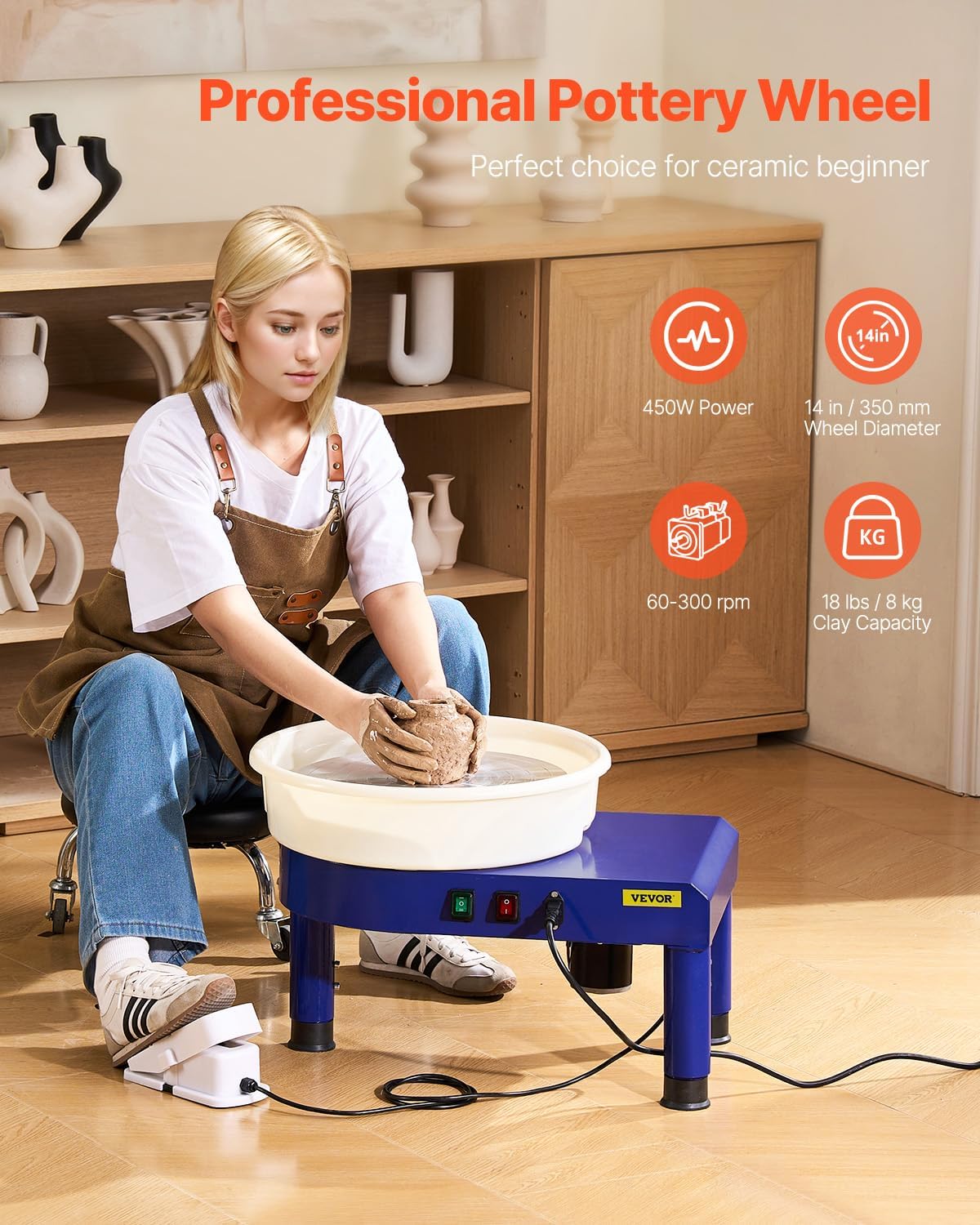
A pottery wheel is the largest upfront capital expenditure in a non-kiln studio setup — and the one where a wrong decision is most expensive to reverse. Wheels in the beginner-to-mid range span roughly $400 to $2,200, and the gap between a $450 entry model and a $900 prosumer model is more significant than the price ratio suggests.
The Three Variables That Actually Matter
Motor torque, not horsepower marketing. Wheel manufacturers rate motors in fractional horsepower (HP), but the number that actually determines performance under load is torque — the rotational force that keeps the wheel spinning consistently when you’re centering a heavy lump of clay. A 1/4 HP motor on a budget wheel can stall during aggressive centering of 10+ pounds of clay. Skutt’s wheel documentation and published specs note that their Pacifica GT400 (1/3 HP) and GT800 (1 HP) are designed for different use cases: the GT400 for students and light production, the GT800 for potters centering up to 25 lbs in a production context.
Centering capacity, not theoretical maximum. Manufacturers list maximum clay capacity, but experienced potters consistently note (as Popular Pottery’s wheel reviews document) that comfortable working capacity is roughly 60–70% of stated maximum. A wheel listed at 25 lbs maximum is a 15–17 lb practical wheel for most sessions. Keep that math in mind when you’re evaluating whether a wheel will grow with your practice.
Reversibility and speed range. Some production techniques — particularly faceting, certain hand-building hybrids, and left-handed throwing — benefit from a wheel that runs in both directions at variable speed. Most wheels above $600 offer this; most below $500 do not, or offer it only as a limited feature.
The Tier Decision
$400–$650 (True entry-level): Wheels in this range — the Speedball Clay Boss is the category benchmark — are viable for students and occasional hobbyists. Published specs put the Clay Boss at 1/3 HP and a 100 lb wheelhead, which is adequate for pots up to about 8–10 lbs of working clay. Owners consistently report that the nylon gears are the first failure point after extended use. If you’re throwing more than two sessions per week, you’ll likely outgrow this tier within 18–24 months.
$800–$1,400 (Prosumer / serious hobbyist): This is the tier where most practitioners with 6+ months of consistent throwing experience should be evaluating. The Skutt Pacifica GT400 and the Brent CXC are the two most frequently cited in this range by Ceramic Arts Network’s buying guidance. Both offer 1/3–1/2 HP motors, reversibility, and build quality designed for multi-year daily use. Published specs for the GT400 note a 25 lb centering capacity and a foot-pedal speed control that operators consistently describe as smooth and linear.
$1,500–$2,200 (Production-entry): The Skutt Pacifica GT800 and Brent IE sit here. These are the wheels most community studio directors specify for shared-use studio floors, according to published procurement guidance from several university art departments. If you are doing production work — making sets of matching forms, throwing 20+ pots per session — the torque headroom justifies the investment. If you’re a dedicated hobbyist, it probably doesn’t.
The Tradeoff Table
| If your situation is… | Then the right move is… |
|---|---|
| Throwing once a week, exploring the craft | $400–$650 entry wheel; upgrade in 2 years |
| Throwing 3+ times weekly, building toward production | Skip the entry tier; buy the $900–$1,100 prosumer range now |
| Running a shared home studio or teaching | $1,500+ production wheel; it’ll outlast two cheaper wheels combined |
| Renting studio space while you decide | Don’t buy yet; use studio wheels for 6 months to calibrate your needs |
What to Defer (and Why)
Two categories of equipment regularly tempt new studio builders before they’re warranted:
Slab rollers — mechanical devices that roll clay to a uniform thickness for hand-building. Useful, space-consuming, and expensive ($400–$900). Most hand-builders can accomplish comparable results with a rolling pin and guide sticks for two to three years before a slab roller earns its footprint. Defer unless you’re specifically doing large-format slab work from day one.
Pugmills — machines that reconstitute and de-air scrap clay. Genuinely valuable in a production context; completely unnecessary until you’re generating meaningful scrap volume. A $1,200–$2,500 investment that makes sense at year three, not year one.
The Ceramic Arts Network’s studio setup guide recommends that beginning practitioners invest the deferred equipment budget into higher-quality consumables — better clay bodies, reliable underglazes, and a proper ventilation fan — before scaling into machinery.
Putting It Together: The If/Then Decision Rules
If you’re setting up a first studio with under $600 total: Prioritize the functional tool kit ($100–$140) and a good apron ($60–$80), and put the remaining budget toward studio time on quality wheels rather than buying your own. Buying before you’ve logged 50+ hours of throwing time risks purchasing for who you are now, not who you’ll be in a year.
If you’re transitioning from a shared studio to a home studio: The wheel decision is your critical path. Match your wheel to your actual throwing habits — not your aspirational ones — using the tier table above. Add a bat set, a full trimming toolkit, and both apron types before you consider any powered equipment.
If you’re building a teaching or production studio from scratch in 2026: Budget $1,500–$2,200 for the wheel, $200–$300 for a comprehensive tool set, and don’t compromise on the apron or safety footwear. The capital items last a decade or more; the consumables don’t, and that’s the budget line you’ll revisit every season.
Your kiln decision — the firing system that makes clay permanent — is a separate conversation with its own depth. For a full treatment of entry-range kiln options (Skutt KM-818, Paragon Caldera) and the electrical requirements that govern home studio installations, see the kiln buying guide on this site. Tools and a wheel get you throwing; the kiln gets you finishing.